
Early access · Release date: September 3, 2020
UpdatedULTRAKILL God Explained: Testaments, Hell, and Heaven
Explore ULTRAKILL god lore through the Testaments, Lucifer's punishment, Hell's creation, and Gabriel's rebellion to understand why the Father disappeared.
Jump to
Why Did God Leave in ULTRAKILL?
The central tragedy of ULTRAKILL god lore is a creator who comes to hate the consequences of his own decisions. The Testaments trace his collapse from anger at humanity to guilt over Hell and Lucifer’s punishment. His disappearance leaves Heaven’s Council enforcing a system whose creator has already lost faith in it.
That absence matters every time Gabriel invokes divine authority. Heaven continues issuing orders, condemning souls, and demanding obedience while the Father’s own words reveal regret about the suffering he created.
God is also a character with limits. He fails repeatedly in his attempts at creation, struggles with his emotions, and admits that he cannot undo Hell. Those failures connect the cosmic history to the game’s larger pattern: creators build instruments of violence that outlast their intentions.
Official page: ULTRAKILL (store.steampowered.com)
The Five Testaments Explain God’s Collapse
The Testaments deliver God’s story through terminals at the ends of specific secret levels. Read them in numerical order to follow the change in his thinking.
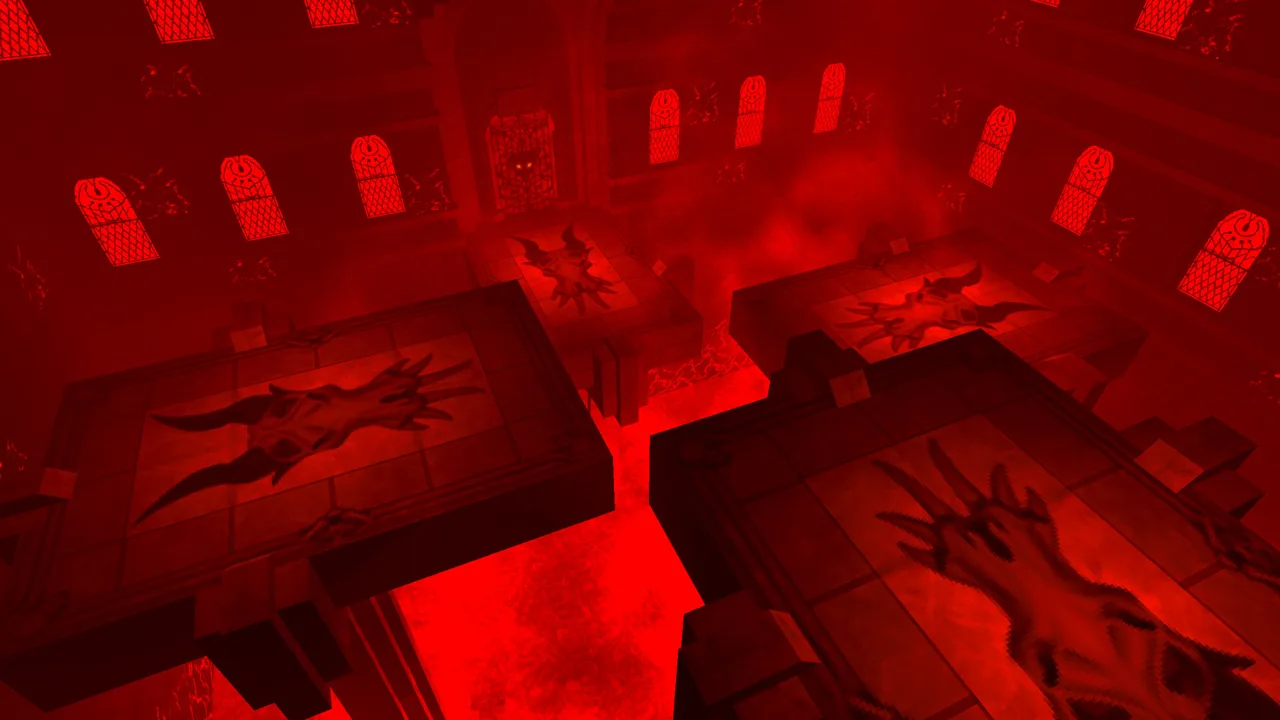 Image: Steam / Arsi 'Hakita' Patala
| Testament | What it reveals |
|---|---|
| I | God condemns humanity and free will, then resolves to begin creation again under his law. |
| II | Repeated failures erode his confidence. |
| III | Attempts to create a mind without free will fail; God condemns humanity to Hell and cannot undo his creation. |
| IV | Lucifer questions eternal punishment, and God responds by casting him into Hell before sinking into remorse. |
| V | Guilt leaves God feeling empty and seeking an end to his existence. |
His judgment of humanity becomes a judgment of himself
The opening Testament presents a creator certain that his creation is the problem. Humanity has failed, so he identifies freedom of choice as the defect to eliminate.
The later entries undermine that certainty. Repetition produces exhaustion rather than a successful replacement. By Testament III, his creative failures have become the justification for punishing humanity.
Read that transition closely: God’s frustration with his own inability to produce the desired result turns outward into eternal suffering. His authority lets him impose punishment, but it does not give him a satisfactory explanation for its cruelty.
Testament V describes a desire for death
The fifth entry moves beyond disappointment in humanity. God now focuses on the hatred and pain his own mistakes have caused, and he seeks an end to his days.
Its closing image has the abyss turning away from him. The passage leaves him confronting despair without relief. Read it alongside the earlier entries: his emotional retreat begins with failed creation, deepens through Hell, and becomes unbearable after Lucifer’s banishment.
Why God Sent Lucifer to Hell
Lucifer’s role exposes the moral failure at the center of divine punishment. He asks his Father whether endless torture can be a proportionate response to foolishness.
 Image: Steam / Arsi 'Hakita' Patala
God cannot answer. His response comes from fear and weakness: he casts the questioning angel into the very place whose existence Lucifer has challenged.
That makes this version of Lucifer especially significant. The encounter centers on compassion for the damned and a question God cannot bear to face. God then recognizes his response as another terrible mistake.
Read Testament IV beside the account of Minos’s death in 2-2, Death at 20,000 Volts. Both passages show suffering defended through authority. Lucifer questions the punishment itself; Minos’s destruction shows how Heaven’s enforcement crushes an attempt to improve the lives of the punished.
Hell Is Alive, and God Cannot Unmake It
Hell operates as a conscious participant in the story. Its manipulation of encounters turns the descent into something more disturbing than a journey through a fixed prison.
 Image: Steam / Arsi 'Hakita' Patala
Enemies appear through teleportation, passages become traps, and violence becomes entertainment for the intelligence surrounding the combatants. Hell observes humanity’s machinery and adapts what it learns.
God’s admission that he cannot unmake Hell gives this situation its weight. The punishment survives his regret. Removing its creator from Heaven does nothing to release the people trapped inside it.
Keep the two ideas distinct when interpreting the lore:
- God explicitly describes Hell as a creation he cannot undo.
- Hell acts with its own intelligence and appetite for suffering.
Together, they establish a creator who has lost control of a lasting catastrophe. They do not require a battle between God and Hell to explain why his regret changes nothing for the damned.
That pattern also runs through humanity’s machines. Tools designed to win wars sustain increasingly destructive conflict, while their makers struggle to survive the world those tools have helped ruin.
How God’s Absence Shapes Gabriel and Heaven
The Council fills the vacuum left by the Father and continues administering punishment. Gabriel serves as its enforcer, carrying divine certainty into confrontations with the inhabitants of Hell.
Minos begins a peaceful revolution in Lust. Gabriel kills him while invoking the Lord’s will. Sisyphus pursues armed resistance in Greed, and Gabriel suppresses that uprising as well.
These events explain why God’s departure offers no lasting escape. Heaven’s institutions preserve the punishment even as individual rulers challenge it.
The Father’s light becomes a means of control
After Gabriel loses to V1, the Council severs his connection to the Father’s light. He receives a 24-hour deadline before its remaining power fades and he dies.
That punishment gives the Council immediate power over his survival. Its reasoning also reveals how rigidly it understands divine strength: defeat by a machine becomes grounds to accuse Gabriel of betraying his purpose.
Watch the intermission after Gabriel’s first defeat before revisiting the second encounter. It explains why his pursuit becomes so personal. He is fighting under a death sentence, carrying humiliation and anger into Heresy.
Gabriel eventually rejects the Council’s authority
His second defeat in 6-2 breaks that obedience. Reflection follows, then his return to Heaven and slaughter of the Council.
During this confrontation, Gabriel acts without waiting for divine direction. He kills the remaining councilor despite understanding that doing so costs him the route back to the light.
His arc gives free will a concrete consequence. The quality God condemned becomes the means by which an angel finally rejects the institution speaking in his name.
The Tree of Life Connects Creation to Blood
The book in 7-1, Garden of Forking Paths, connects the Father’s Tree of Life to the substance flowing through living bodies. It also identifies the cross used by angels with that tree.
This connection gives blood a religious meaning alongside its practical role as machine fuel. Life, machinery, and sacred imagery share the same physical substance.
The passage then turns that imagery toward mutilation. Bodies become obstacles to exposing blood, organs, and bone, while violence becomes an act of tribute.
Read the entire passage before moving on. Its shift from reverence to cruelty helps explain the atmosphere of Violence: sacred symbols remain recognizable while their meaning becomes grotesque.
The theory that God literally planted his own heart adds a further interpretation to this imagery. The direct connection the passage makes is between the Father, the tree, and the blood that sustains life.
Fraud Adds a Challenge to God’s View of Humanity
Layer 8: Fraud arrived with Patch 17, extending the story beyond Violence. Its archives make the earlier condemnation of humanity more complicated.
Two details matter for understanding the Father’s judgment:
- In 8-2, Through the Mirror, survivors describe cooperation after the Earthmovers’ collapse, including shared research, communication between communities, and efforts to pool resources.
- In 8-3, Disintegration Loop, an archive describes successful animal cloning and the gradual return of meat to people’s diets.
These passages show people responding to disaster with reconstruction. Scarcity creates a common purpose, and communities work together after enduring the Final War.
That gives God’s dismissal of humanity something concrete to answer to. Human beings produce extraordinary cruelty, but they also rebuild, share, and care for one another.
The hidden mirror passages in Fraud push toward a much darker account of existence, returning to war, consumption, and suffering. Read the ordinary archives before their mirror counterparts. The contrast puts hopeful human effort beside a voice that reduces life to violence, leaving the player to confront how much that darker judgment erases.
Continue with
 ULTRAKILL Lore Explained: V1, Gabriel, and Hell's FallExplore ULTRAKILL lore, from the Final War and V1's creation to Gabriel's rebellion, Prime Souls, and the disturbing truth behind Hell and the New Peace.
More in Lore
ULTRAKILL Ending Explained: Gabriel, Fraud, and Fate
Explore the ULTRAKILL ending through Gabriel's rebellion, the Earthmover's destruction, and Fraud's finale, with a clear look at where the story stands.
ULTRAKILL V1 Lore: Origins, Blood Fuel, and Rivalries
Discover ULTRAKILL V1 lore, from its wartime origins and blood-powered armor to its rivalry with V2 and the battles that change Gabriel's fate in Hell.
Continue exploring
Join the community
Official channels for news, updates and player help: