
Early access · Release date: September 3, 2020
UpdatedULTRAKILL Lore Explained: V1, Gabriel, and Hell's Fall
Explore ULTRAKILL lore, from the Final War and V1's creation to Gabriel's rebellion, Prime Souls, and the disturbing truth behind Hell and the New Peace.
Jump to
What Is ULTRAKILL’s Story About?
Hell is becoming a feeding ground for the weapons humanity left behind. ULTRAKILL lore follows V1, a machine that survives on blood, as its descent collides with Heaven’s authority and the ruined lives of the damned. Understanding that history turns abandoned cities, towering war machines, and Gabriel’s anger into parts of a much larger tragedy.
Humanity is already extinct when the game begins. With blood running out on Earth, machines enter Hell to find more. V1’s immediate purpose is survival, but its victories help unravel an order that was unstable long before its arrival.
Three overlapping histories explain the world you fight through:
- Heaven’s crisis: God disappears, and an angelic council takes control.
- Humanity’s collapse: A war lasting about 200 years produces blood-powered machines, followed by reconstruction and expeditions into Hell.
- The machine invasion: Machines consume Hell’s inhabitants while Gabriel struggles to stop them.
Those histories intersect without providing a precise date for every event. Follow the sequence within each storyline instead of trying to force everything onto a single calendar.
Spoilers ahead for Acts I–II, Violence, Fraud’s archive passages, and both Prime Sanctums.
Official page: ULTRAKILL (store.steampowered.com)
God’s Disappearance and the Council of Heaven
The Testaments reveal a creator consumed by disappointment, anger, and regret. God condemns humanity’s behavior and comes to regard free will as a flaw. Repeated attempts to create a mind without it fail, undermining his faith in his own work.
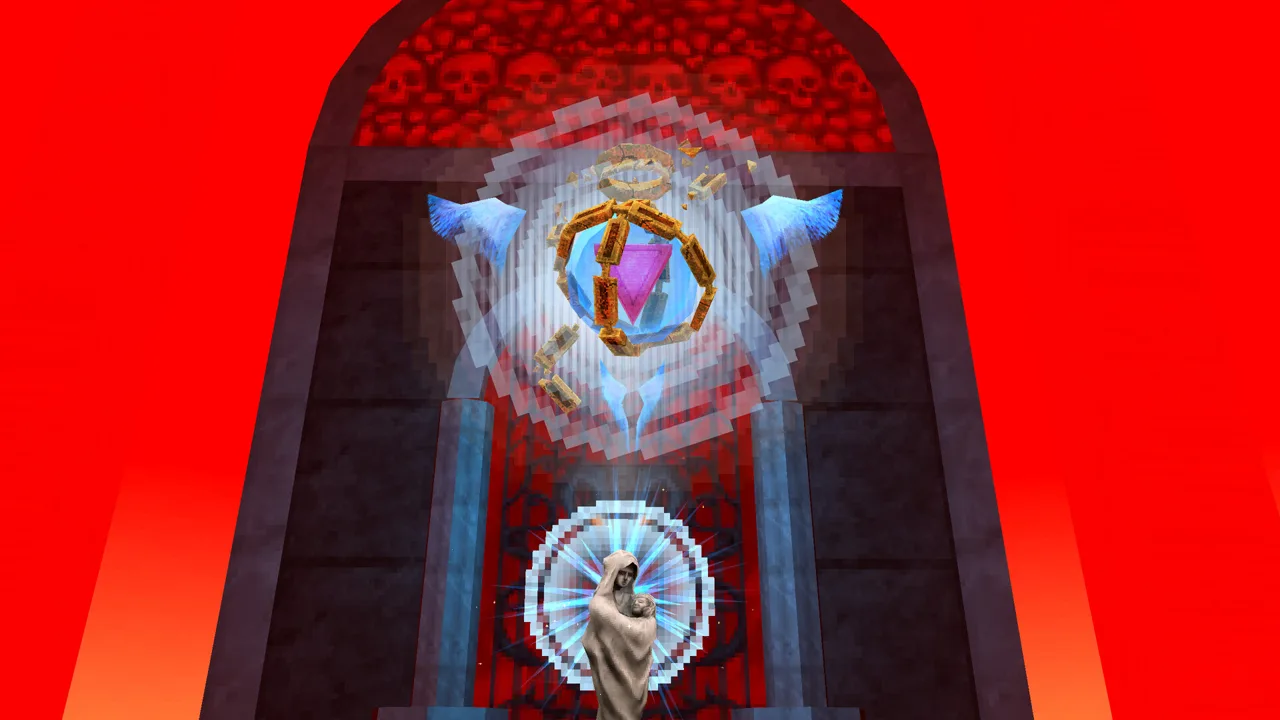 Image: Steam / Arsi 'Hakita' Patala
Hell becomes his most terrible mistake. After creating it, God finds himself unable to undo it.
The Testaments grow increasingly despairing as their speaker confronts the suffering his actions have caused.
Eventually, God’s presence disappears from Heaven.
How the Council Maintains Control
The Council of Heaven assumes authority in God’s absence and continues enforcing punishment below. Gabriel serves as its powerful executor, suppressing resistance and defending the hierarchy.
The council can sever Gabriel’s connection to the Father’s light. That power becomes central to the campaign: after his defeat by V1, Gabriel receives a sentence that leaves him with only 24 hours before the remaining light fades and he dies.
This arrangement gives Heaven’s rulers control over an angel capable of extraordinary violence. Gabriel’s strength does not initially give him independence; his obedience keeps that strength working for the council.
The tension runs through the whole story. Heaven continues issuing judgments under an absent creator’s authority, while the damned bear the consequences.
The Final War, Earthmovers, and V1’s Creation
The Final War lasted about 200 years. Its escalating arms race culminated in the creation of the Earthmovers.
The Gutterman Poem Makes War Personal
The poem hidden in a Gutterman coffin in 7-2 gives warfare an intimate, disturbing perspective. Its speaker addresses a mother whose blood provided nourishment, remembering her painful breathing inside an iron tomb.
The speaker longs for that mother. That passage gives a war machine an emotional life built around dependence and grief.
Earthmovers Made the Planet Uninhabitable
Earthmovers brought the arms race into its final era. These enormous walking fortresses could destroy entire cities and carried shields that forced attackers to approach from within.
Their size demanded both blood and solar power.
As the surface became uninhabitable, surviving civilians built settlements on their backs. Humanity took shelter aboard the machines devastating its world, while smaller machines fought across their structures.
Eventually, smoke, soot, and destruction blocked the sun. During this Long Night, Earthmovers lost the sunlight they needed and shut down one after another. Warfare had become so dependent on them that large-scale conflict could no longer continue.
Humanity survived the war and began rebuilding.
Why V1 and V2 Are Different
V1 was developed for warfare, using experimental plating that absorbs fresh blood directly to replenish itself during combat. Its small, mobile design fits the task of penetrating an Earthmover and destroying it internally.
The +RAISON D’ETRE style bonus added in Fraud Hotfix #2 connects the Earthmover’s destruction to V1’s purpose. The phrase means a reason for existence.
V2 followed during the New Peace. Its design traded V1’s blood-absorbing plating for greater durability. V1 and V2 are prototypes.
That difference matters whenever they fight. V2 can withstand punishment, while V1 can recover through continued close combat. The behavior the game rewards is built into its protagonist’s body.
The New Peace and Humanity’s Exploration of Hell
The New Peace gives humanity a chance to repair the damage left by the Final War. Communities begin cooperating to restore a livable world.
Fraud’s archives make this recovery unusually tangible.
What Fraud Adds to Humanity’s History
An archive in 8-2: Through the Mirror describes survivors salvaging technology from their former Earthmover home, 15H-KUR. They establish two-way audio communication with four other communities and reconstruct a system for locating additional Earthmover settlements.
Small blood donations help power that reconstruction. Shared work and renewed contact improve morale.
Another archive, in 8-3: Disintegration Loop, describes successful animal cloning. A community has cloned a pig, becoming the fourth to follow an earlier cow-cloning project, and meat is gradually returning to people’s diets.
These details give the New Peace weight. People rebuild communications, restore food supplies, and reconnect with distant survivors. Their extinction destroys a recovery that had already begun producing results.
The Hell Exploration Project
Humanity discovers an entrance to Hell and begins exploring it for resources. Machines scout dangerous territory, while terminals and infrastructure support the project.
Hell itself interferes.
Doors lock, creatures appear through teleportation, and equipment disappears. Exploration exposes humanity’s technology to an intelligence capable of learning from it and turning it into further instruments of suffering.
The Ferryman’s diary captures the human catastrophe from below. The River Styx swells into an ocean under the arrival of vast numbers of souls, then experiences an overwhelming surge.
By V1’s descent, humanity is gone and the surface’s remaining blood is running out. That shortage sends machines into the same depths humans once tried to explore.
King Minos, King Sisyphus, and the Prime Souls
God’s disappearance creates an opening for resistance in Hell. Minos and Sisyphus respond differently, but both challenge Heaven’s insistence that punishment must continue.
Minos and the Lust Renaissance
King Minos rejects the idea that love deserves eternal torment. During Heaven’s disorder, he helps transform Lust into a thriving civilization, offering its inhabitants something beyond punishment.
The council sends Gabriel to end that transformation.
Minos attempts to reason with him. Gabriel kills him, and the Lust Renaissance collapses. Minos’s immense husk later becomes a parasite-controlled threat to the city he worked to build.
His soul remains imprisoned inside the Flesh Prison, aware of his body’s destruction.
Sisyphus and the Greed Insurrection
King Sisyphus organizes armed resistance in Greed. His followers seek freedom through force, rejecting the hope that Heaven will willingly release them.
What Makes a Prime Soul Dangerous?
A Prime Soul possesses enough will to manifest without a husk. That independence makes it a threat Heaven cannot neutralize simply by destroying its physical body.
Minos emerges after V1 destroys the Flesh Prison.
Minos condemns the machines’ crimes against humanity.
Gabriel’s Defeats and Rebellion
V1’s victories force Gabriel to reconsider his obedience to the Council of Heaven.
Act I: Authority Meets Defeat
Gabriel confronts V1 in Gluttony, ordering it to abandon its descent. He presents himself as the righteous hand of the Father and expects to destroy the intruder.
V1 defeats him.
Back in Heaven, the council treats that loss as an offense against its authority. It severs his connection to the Father’s light, making victory over V1 his route back to survival.
Gabriel returns to Hell humiliated and furious.
Meanwhile, V1 continues through the layers, defeats V2 again in Greed, and destroys its rival. Other machines are advancing too; the devastation extends beyond V1’s individual path.
Act II: Hatred Gives Way to Independence
V1 is part of an invasion consuming Hell’s inhabitants.
Gabriel’s second defeat breaks his old certainty.
He experiences the fight differently, finding something exhilarating in a challenge his authority cannot settle. Afterward, he reflects on the council’s rule and his own obedience.
He then returns to Heaven and kills the council members.
The final councilor warns that killing him will leave Gabriel without a way to reconnect to the light. Gabriel proceeds with full awareness of that consequence.
His rebellion carries a cost he accepts. Having spent so much of the story enforcing another authority’s will, he finally chooses how to use the time left to him.
Hell Is Alive, and the Terminals Want Entertainment
Hell has agency. It observes, learns, manipulates its surroundings, and arranges violence for its own enjoyment.
That changes the meaning of familiar combat encounters. A sealed arena can represent an intelligence trapping its inhabitants together. Teleporting enemies can be part of a deliberately staged confrontation.
Human technology gives Hell additional tools. Soldiers combine husks with mechanical alterations, while the cruelty of Guttermen inspires further forms of punishment.
Fraud’s Books Complicate What You Read
Fraud places hopeful human archives alongside disturbing passages associated with mirrors and books whose pages appear blank.
The archive entries describe cooperation and recovery. The stranger texts insist on cruelty, consumption, and endless conflict.
Read those voices separately. A survivor describing reconstruction and a voice celebrating torment have different motives and perspectives. Their disagreement is part of the story.
Why Terminals Reward Style
Terminals develop their own appetite for entertainment.
Machines record their battles, and terminals grade the recordings for entertainment value. Points become payment for goods and services, including weaponry. The terminals also build social status around the combat footage they acquire.
The Cyber Grind extends that arrangement through simulated combat.
This gives the scoring system a place within the fiction. A machine needs weapons to survive, and a terminal wants exciting recordings. Stylish violence keeps their exchange moving.
Hell and the terminals each benefit from continued fighting, even though they occupy very different roles in the world.
Where to Find the Story While Playing
Read enemy data after encounters, revisit quiet rooms containing books, and explore secret missions. Major revelations sit outside the main route, especially the Testaments and Prime Sanctum endings.
| Location | What to read or complete | What it explains |
|---|---|---|
| 2-2: Death at 20,000 Volts | The book describing Minos’s death | Gabriel’s role in ending Minos’s rule |
| 4-2: God Damn the Sun | The account of preparations for rebellion | The Greed Insurrection’s aims |
| 5-2: Waves of the Starless Sea | The Ferryman’s diary | The influx of human souls and Gabriel’s compassion |
| 7-2: Light Up the Night | The poem in the Gutterman coffin | Machine consciousness, dependence, and grief |
| 7-4 | Earthmover data | The Final War’s escalation and aftermath |
| 8-2 and 8-3 | The human archive passages | Reconstruction during the New Peace |
| P-1 and P-2 | The bosses and ending terminals | Prime Souls and the terminals’ behavior |
The optional encounters bring you face-to-face with the imprisoned souls:
- P-1: Soul Survivor: Minos emerges after V1 destroys the Flesh Prison.
- P-2: Wait of the World: Sisyphus Prime breaks out of the Flesh Panopticon.
Collecting every secret orb and completing every level challenge are separate goals.
For God’s storyline, read the Testaments found in secret levels. For the story’s response to despair, spend time with 2-S: its conversation explores fear of death, personal purpose, and the possibility of choosing a meaningful life.
Continue with
 ULTRAKILL V1 Lore: Origins, Blood Fuel, and RivalriesDiscover ULTRAKILL V1 lore, from its wartime origins and blood-powered armor to its rivalry with V2 and the battles that change Gabriel's fate in Hell.
More in Lore
ULTRAKILL Ending Explained: Gabriel, Fraud, and Fate
Explore the ULTRAKILL ending through Gabriel's rebellion, the Earthmover's destruction, and Fraud's finale, with a clear look at where the story stands.
ULTRAKILL God Explained: Testaments, Hell, and Heaven
Explore ULTRAKILL god lore through the Testaments, Lucifer's punishment, Hell's creation, and Gabriel's rebellion to understand why the Father disappeared.
Continue exploring
Join the community
Official channels for news, updates and player help: